Showing posts with label Herbs. Show all posts

May 10, 2011

First Tomatoes

Over the last week, while I have been holed up inside, the tomatoes were starting in the vegtable garden. I wasn't sure whether the title of this post fit, because the tomatoes are not ripe yet, but early signs of the deliciousness to come is something to celebrate. Pictured below is 'Smarty' Grape Tomato, a purchase from my local plant indulgence, Fairview Garden Center.


The 'Mountain Fresh' Tomatoes are also producing small green fruits, but they will take much longer to mature into large red slicing tomatoes.  This little powerhouse pictured below is the only hybrid of my tomatoes, and has been producing huge yellow flowers for weeks now. A product of the NC State University breeding program, this is part of the 'Mountain series' which touts disease and crack-resistant fruits with a great taste. Ive grown 'Mountain' tomatoes for 3 seasons now, and they are always the most prolific producers. It has about the best taste I've had for a hybrid, and although it might not taste quite as good as the heirlooms, I grew 3 plants of this variety because its perfect for canning and makes an amazing salsa. Plus I love growing a local variety, that way I know its going to preform well in the North Carolina heat.


The tomatoes are filling out nicely. You can see my original plant list on my Preparing the Vegtable Bed Post, although I've swayed only a bit..  For tomatoes I'm growing 2 'Green Zebras', 3 'Mountain Fresh', 1 'Smarty Grape', 2 'Black Krim', and 1 unknown heirloom that was in the 'Black Krim' seed packet which looks to be 'Brandywine' or 'German Johnson'. I just couldn't resist planting it to see what it was. I also added some Italian oregano and lemon grass at the far end.


The larger cages in the picture above were a great find, left by the previous homeowner and obviously handmade from fencing. At 6 feet tall they are about they best support you could ask for. You will also notice the marigolds scattered throughout the vegetable bed. Although I'm not a huge fan of the marigold look (too common perhaps) they do bring some amazing benefits. Besides being deer resistant, they help keep aphids away and their roots secrete toxins that help treat soil nematodes that are harmful to vegetables. I figure its worth the 6 bucks for a couple six packs!


Holy hops! The hops are growing fast, and since I took this picture a couple days ago, the 'Centennial' hop vines have already met in the middle of the grape trellis. They grow 4-6 inches a day right now, and should set cones within a month, hopefully, otherwise the heat will start to stunt them. The dill is also going crazy. I use fresh herbs almost every day in cooking, I can always find a way to make them fit, but I still grow too much. Good think a couple friends joined me to help eat the dill. I expect the swallowtails to come every year, so I plant a few extra dill seeds to share.


To add a little color, the chives added some blooms. The first is beginning to open, but there are signs of more to come. I probably use these the most of all my herbs, as the onion taste works with all types of dishes.


So begins the summer vegetable garden. I wonder how long until my little green tomatoes will be ripe enough for a salad...

"I love to think of nature as an unlimited broadcasting station, through which God speaks to us every hour, if we will only tune in."  ~George Washington Carver

April 10, 2011

Preparing the Vegtable Bed

Today is the official last frost date for Raleigh! Ive been waiting for months, but its finally time to put in the warm weather vegetables. But first, some work had to be done...


Having our raised vegetable bed on a moderate slope, summer irrigation waters slowly wash down the organic matter, leaving the top layer of the soil with mostly sand. To remedy this, and add nutrients to the bed, each spring we prepare the vegetable bed by turning composted cow manure into the top 6-10 inches of soil. We also apply earthworm castings and TomatoTone to the top of the soil after planting.

However, this was not the first step in preparing the vegetable bed: it was harvest and clean up! The first thing to go were the Brussels Sprouts. Planted late in the fall, these guys shot up after overwintering, and although sprouts were beginning to form along the stem, the warm weather caused them to flower and the sprouts stopped developing when only the size of peas. We left them in for a few weeks to enjoy the flowers, but they ultimately ended up in the compost pile. The spinach and parsley fared better, although what looked like a bountiful harvest of spinach turned out to be infested with aphids. The parsley was really the standout, and the 10 plants I started from seed last spring yielded a huge bag of parsley. The individual plants were very impressive, the largest measuring over 1-inch in diameter at the base (pic below left). I was able to get 13 bunches of parsley out of this. Figuring out what to do with it has been the hardest part, and everyone Ive asked either has parsley or does not use it. Luckily an area garden center patricipates in Plant a Row for the Hungry, a great program that delivers fresh produce to those in need, and they will take my parsley! The 'Quinault' strawberries were left in place (below right), and are now covered in little white flowers, a promising sign of a big May harvest.


 I already put a few herbs and veggies in, but have plans for more. Ive learned over the last few seasons what I do and do not use from the garden, and have put together a good list of edibles for this year.... although I'm sure I will be forever adding to it!


Herbs in the garden:
  • Sweet Basil
  • Genovese Basil
  • Flat-leaf Parsley
  • Boquet Dill
  • German Thyme
  • Chives 
  • Kentucky Colonel Mint
  • Arp Rosemary

Veggies in the garden:
  • 'Mountain Fresh' Tomatoes
  • 'Green Zebra' Tomatoes
  • 'Black Krim' Tomatoes
  • 'Smarty' Grape Tomato
  • 'Brandywine' Tomato
  • Jalapeno Peppers
  • Mixed Bell Peppers
  • 'Black Beauty' Zucchini
  • Straight-neck Summer Squash
  • 'Homemade Pickles' Cucumbers
  • 'Kitchen King' Garden Beans

"Shall I not have intelligence with the earth?  Am I not partly leaves and vegetable mould myself."  ~Henry David Thoreau

March 6, 2011

Starting Seeds

With 6 weeks until our last frost date, and plenty of warm, sunny weather, the clock is counting down to get the garden started. Our seeds are well on their way, with the first signs of spring life appearing.


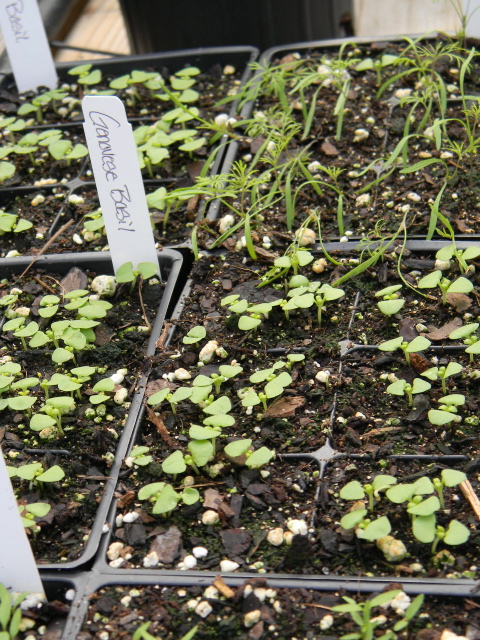
My first crop of seedlings just popped up over the last couple weeks.  These are greenhouse babies, as one of the perks of working in the horticulture business is you can always find some free space for your own projects. 


In years past I have stuck to only starting herb seeds. The things I use most in the kitchen: parsley, basil, and chives I choose to grow from seed so I never run out of herbs to cut. This year, however, Ive gone a little seed crazy (initially as a way to save money, now I just want to experiment with what I can grow). In the greenhouse, Ive started my usual herbs: Sweet Basil, Genovese Basil, Parsley, and Dill. But, I also added a flat of veggies: Bush beans, Pickling Cucumbers, and Jalapenos.  Everything seems to be up and growing, their cotyledons (seed leaves) just unfurling show signs of the first real leaves. 
 Two flats was the limit of my greenhouse space, and wanting more I decided to try a type of grow box at home. In this flat I started a mixture of some interesting veggies and perennials. When we went to visit Jesse Israel and Sons Nursery in Asheville, NC I could not help grab a few seed from their huge collection. I'm most excited about the tomatoes, an heirloom 'Black Krim' variety from Russia that is supposed to have a unique salty taste. Also at the Nursery in Asheville, I grabbed this great topper for about 1 buck, which fits a standard flat, and in a sunny location its working its magic. No sprouts in these yet, although its been about 10 days. I attribute the delay to the luke-warm temps and rain we've had latley, but they still have plunty of time to build up that energy and sprout.

And then this is where I got a little seed crazy. Watching the birds start their spring courtship made me think of sunflowers. We always have a feeder full of sunflower seeds that the birds devour. I just couldn't resist these mammoth sunflowers. I'm a sucker for anything tall in the garden. Plus I've actually never used a jiffy seed starter. I figured its worth a shot as they are so popular, and the windowsill version was only about 3 bucks.


"Adopt the pace of nature:  
her secret is patience." 

~Ralph Waldo Emerson

February 20, 2011

Surviving Veggies

Although by June I'm cursing the heat in Raleigh, I do love our mild winters. So mild, in fact, that we can grow some herbs and veggies year round! Besides gardening, cooking is another one of my passions, and I love where the two intersect.

We inherited this raised bed on the side of our house from the previous owners, an elderly couple who also loved to garden. Since this is a South facing exposure, they used it to grow annuals. We found it was more useful for us as our herb and vegetable garden. 

The trellis is one of Brian's projects, originally designed for Grapes, it now is used for growing Hops. I think it is a great way to make a bare wall interesting!

Besides our veggies, we do have a few perennials in the foreground. Some gorgeous Irises that one of Brian's co-workers brought to work 3 years ago have multiplied and will burst into a deep purple bloom in May. And we have a Yarrow stuck in there somewhere, a great "biocontrol" plant which attracts beneficial insects to the garden.

There is also a patch of 'Quinault' strawberries, which I guess is a fruit not veggie, but its perennial nature makes it a great transition plant to the perennials at this end. We got these strawberry plants late last year and only got a couple berries in the fall, but I'll let you know how they do this spring, as they are supposed to be a great all-season variety.

Brussels Sprouts
Lettuce Mix
This winter we chose some basic veggies that we could start from seed: spinach, lettuce, Brussels sprouts, and cilantro. The lettuce, a Mesclun Mix, was the stand out performer, and lasted through the snow beautifully. However, as you can see, no Brussels Sprouts to harvest yet, maybe with the warmer weather they will continue to grow... I'm not holding my breath. I wish things would have turned out better with them, but we got things in the ground a little too late. That seems to be the problem with Raleigh weather, our tomatoes last until October, making us not want to till the garden until late in the season, but in doing that we miss the best window for winter plantings!

Italian Parsley
Chives
 I also have been doing a little experimenting with which herbs will survive the winter in Raleigh. I know Cilantro will tough through, and have grown in for a few years now. This year I decided to let the Parsley go and see how it would handle the cold. I was amazed at its resilience! I could cut some sprigs, which looked wilted in the cold, and as soon as I put them in water in the warm kitchen they perked right back up and were great for cooking! Chives were another experiment, although I knew they were perennial bulbs. The foliage died down in late December, but since having these warm spells has sent up luscious new growth that I should be able to harvest in a few weeks!

Viola 'Marley'


And lastly, I had to show just a little color! I figured I'd include this one in the veggie post since the flowers are edible. This 'Marley' Viola toughed it out all winter in its pot and just put out a new flush of delicate violet flowers. I normally tend to go for Pansies over the smaller Viola's for winter color, but I couldn't pass up this little gem!